


PRESS RELEASE: SURGE OF SARS-COV-2 INFECTIONS IN SOUTH AFRICA DUE TO NOVEL VARIANT, MANUSCRIPT PUBLISHED IN NATURE
IMMEDIATE RELEASE: 09 March 2021 at 1000 London time (GMT) / 0500 US Eastern Time.
A new SARS-CoV-2 variant that rapidly became dominant in parts of South Africa towards the end of 2020 may have emerged from the coast of the Eastern Cape Province after the first wave of the epidemic, suggests a study published by Prof. Tulio de Oliveira and colleagues in Nature today. The rapid displacement of other SARS-CoV-2 lineages in multiple regions indicates that this variant has an advantage over these other strains, possibly owing to increased transmissibility and/or it’s ability to avoid the immune system.
“In November 2020, Prof. Tulio de Olivera, head of the Network for Genomic Surveillance in South Africa (NGS-SA), phoned me – he was worried as he had found a new variant with an unexpected number of mutations in the spike protein – a region included in most vaccines.” commented Prof. Carolyn Williamson from University of Cape Town and National Health Laboratory Services, and a lead member of NGS-SA. “At UCT, we rapidly sequenced viruses and found more than half the viruses transmitted in the Western Cape contained these mutations, and by December, this virus had essentially replaced the previously circulating variants. This rapid emergence suggested this variant was better at spreading, and subsequent data showed that it could also impact on vaccine efficacy”, concludes Prof. Carolyn Williamson.
The second wave of the SARS-CoV-2 epidemic in South Africa began around October 2020 and was notably rapid in parts of the Eastern Cape, Western Cape and KwaZulu-Natal Provinces, prompting an intensification of genomic surveillance. A new SARS-CoV-2 variant (named 501Y.V2 / B.1.351) was identified by the NGS-SA through the analysis of 2,882 SARS-CoV-2 whole genomes from South Africa, collected between 5 March and 10 December 2020. Their data suggested that the new variant emerged around August 2020 in Nelson Mandela Bay, becoming the dominant lineage in the Eastern Cape, Western Cape and KwaZulu-Natal by the end of 2020.
“The NHLS laboratories played an important role in acting quickly in the discovery of the new variant as we could quickly sample 100s of health care facilities” Says Prof. Koleka Mlisana, Executive Manager: Academic Affairs, Research & Quality Assurance at the NHLS. “We found that the NGS-SA allowed South Africa to quickly and accurately identify the 501Y.V2 variant. We now want to continue working together to expand this technology to other important pathogens in the country, such as HIV, TB, Hepatitis virus” concludes Prof. Koleka Mlisana.
The 501Y.V2 variant is defined by eight mutations in its spike protein, which mediates cell entry. One of these mutations, N501Y, is also present in a variant identified in the UK (B.1.1.7), and is associated with enhanced binding to the human ACE2 receptor. Another mutation, E484K, has been associated with resistance to neutralizing antibodies. The distribution and spread of 501Y.V2, along with insights from genomic analysis, suggest that the variant may be more transmissible than other SARS-CoV-2 lineages. However, the full import of the mutations is not yet clear and requires further study, the authors conclude.
“This was the first paper that described the 501Y.V2 variant. Since the discover of the variant, scientists in South Africa have worked relentless to advance the science” says Prof. Tulio de Oliveira, director of KRISP and lead of NGS-SA. Novel results presented last week to the Ministers of Health and Science and Innovation in South Africa, show that people recently infected with 501Y.V2 produce broad neutralizing antibodies that neutralize 501Y.V2 and other variants. The focused and collaborative way that South African scientists worked so to understand this variant has been inspiring and exciting” concludes Prof Tulio de Oliveira.
#### FOR MEDIA CONTACT
Nobhongo Gxolo, Communications officer, Institute of Infectious Diseases and Molecular Medicine (IIDMM), UCT, Cape Town.
Email: nobhongo.gxolo@uct.ac.za
Tel: +27 21 4067006
AND/OR
Paul Harris, Media Liaison, KwaZulu-Natal Research Innovation and Sequencing Platform (KRISP), UKZN, Durban.
Email: paul@htagmedia.co.za
Tel: +27 82 806 6290
### About the Network for Genomic Surveillance in South Africa (NGS-SA) ### In response to the COVID-19 pandemic, we created the Network for Genomic Surveillance in South Africa (NGS-SA) in May, 2020 with grants from the South African Medical Research Council and the South African Department of Science and Innovation (DSI). Our goal is to sequence the genome of at least 10,000 severe acute respiratory syndrome coronavirus 2 (SARS-CoV-2) samples to inform the public health response in South Africa. As of March 2021, we have sequenced the genome of over 5,000 isolates, which has provided insights into how and when it was introduced into the country and allowed the identification of 501Y.V2. The knowledge that NGS-SA generates is shared with policy makers and developers of vaccines, diagnostics and treatments, allowing South African to be on the cutting-edge of scientific response.
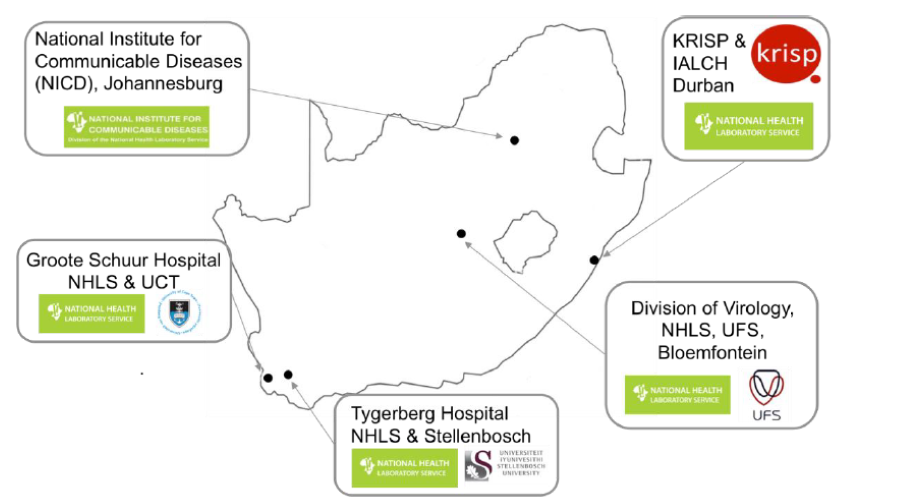
Founding members of NGS-SA include: The KZN Research Innovation and Sequencing Platform (KRISP) at UKZN, the Inkosi Albert Luthuli Central Hospital (IALCH) NHLS laboratory, the National Insititute for Commuicable Diseases (NICD), the Groot Schuur Hospital NHLS laboratory at the University of Cape Town, the Tygerberg Academic Hospital NHLS laboratory, Stellenbosch University and the Division of Virology at NHLS in the University of the Free State (UFS).
For more information, please visit NGS-SA website: https://www.krisp.org.za/ngs-sa/ngs-sa_network_for_genomic_surveillance_south_africa/
#### END
leave a comment here